
Expert Teaching

The Fairfield Expert Teaching Cycle is our shared framework for excellent teaching. It translates the evidence underpinning successful learning and expert teaching into a practical approach that promotes consistency, high standards and positive outcomes for all pupils. Drawing on evidence from cognitive science, the Education Endowment Foundation (EEF), the Great Teaching Toolkit, Rosenshine's Principles of Instruction, Teach Like a Champion, Steplab and the Ambition Institute, the cycle is built on a simple principle: pupils learn best when they pay attention, think hard about important curriculum content and connect new knowledge to existing knowledge in long-term memory.  

The cycle supports teachers to make evidence-informed decisions before, during and after learning takes place through a connected process of planning, instruction, practice, assessment and adaptation. By combining strong subject knowledge, high-quality instruction, responsive assessment and adaptive teaching, it ensures that pupils can think hard, remember more and achieve highly. The Fairfield Expert Teaching Cycle operates across lessons and sequences of learning. Teachers move between its elements responsively; it is not a prescribed sequence for every lesson. 
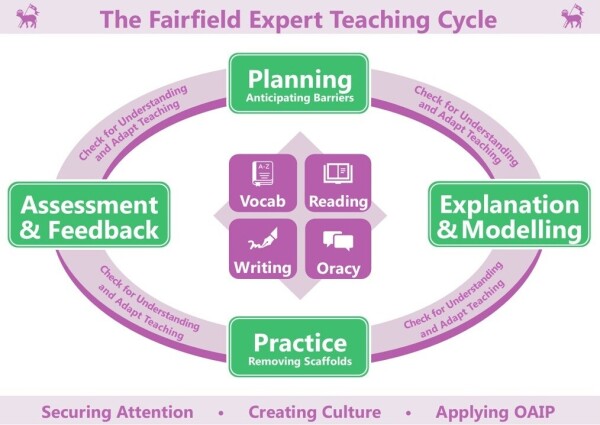


1. Planning: Anticipating Barriers - Effective teaching begins with careful planning that identifies intended learning, prior knowledge requirements and potential barriers. Teachers anticipate misconceptions, vocabulary demands and accessibility needs so that appropriate support can be provided from the outset. 


2. Explanation and Modelling - Teachers introduce new learning through clear explanations and expert modelling. Complex knowledge and skills are broken into manageable steps using worked examples, live modelling and metacognitive talk to build secure understanding. 


3. Practice: Removing Scaffolds - Pupils move from guided practice towards independence. Carefully sequenced practice enables teachers to gradually remove support, helping pupils develop fluency, confidence and long-term retention. 


4. Assessment and Feedback - Assessment is integrated throughout learning to identify strengths, misconceptions and next steps. Feedback is timely, specific and actionable, helping pupils improve and make further progress. 


5. Checking for Understanding and Adapting Teaching - Teachers gather evidence of learning through questioning, discussion and observation. This information is used to address misconceptions, adapt teaching and provide appropriate support or challenge. 

Literacy sits at the heart of the Fairfield Expert Teaching Cycle and underpins success across the curriculum. 


1. Vocabulary - Teachers explicitly teach and revisit subject-specific vocabulary so pupils can understand and communicate ideas with precision. 


2. Reading - Reading is developed across all subjects, enabling pupils to access challenging texts, build knowledge and become fluent readers. 


3. Writing - Teachers provide explicit instruction and practice to help pupils write accurately, fluently and effectively. 


4. Oracy - Structured talk develops language, deepens understanding and helps pupils articulate their thinking with confidence. 

1. Securing Attention - Learning is only possible when attention is focused on the content being taught. Teachers establish routines and minimise distractions to maximise learning. 


2. Creating Culture - High expectations, strong relationships and consistent routines create a positive culture where pupils can participate, persevere and succeed. 


3. Ordinarily Available Inclusive Provision - Inclusive practice is embedded in everyday teaching so that all pupils, including those with SEND, can access an ambitious curriculum. Teachers anticipate and address barriers, adapt support to pupils’ needs and promote participation and independence.